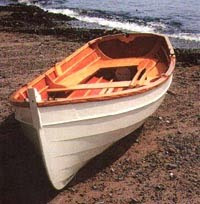
As you can see, it’s been a while since the last post. Much progress has been made and the finished boat is getting easier to visualize…it’s going to be beautiful.
After the building jig was assembled, the legs were adjusted to make the entire assembly level. A support piece for the stem was added and then the station locations were measured and laid out on the jig. The temporary frames and bulkheads were then attached to the jig at their appropriate stations. The transom was attached to a temporary frame with the bottom edge cut at a 25 degree angle giving the transom its needed rake.
After making sure the forward bulkhead was plumb, the stem was attached to it. One of the temporary frames has additional supports added to make it rigid. The keel is attached to the rigid frame and also to the other frames, bulk heads, stem, and transom therefore making the entire assembly rigid. After planing the proper angle on the transom and making some minor adjustments, the keel was screwed and epoxied to the stem, bulk heads, and transom. A quarter knee was added where the transom and keel meet for additional strength. The keel was removed just before being permanently attached to have the edges routered and all surfaces sanded.
The sheer clamps (in-whales) were attached next. Compound angles were cut at the stem along with cut outs in the transom. Next came the stringers which also have compound angles at the stem and cut outs in the bulk heads and transom. The top two stringers on each side were steamed in order for them to accept the twist that is needed to mate them to the stem and the transom. A hand saw, coping saw, and chisels were used to cut the openings in the bulk heads and transom. The stringers and sheer clamps were all removed after the initial fitting to be sanded before being permanently attached. The stringers all extend slightly past the stem so they can be planed to the exact angle needed to match the stem bevel. Much time was spent making sure all of the stringers have fair curves which will be reflected in the planking.
Next up:
- Outer stem will be laminated using the stem as a form.
- Keel, bulkheads, and transom will be beveled.
- Outer skin of the transom will be attached.
Row, row, row your boat...life is but a dream.